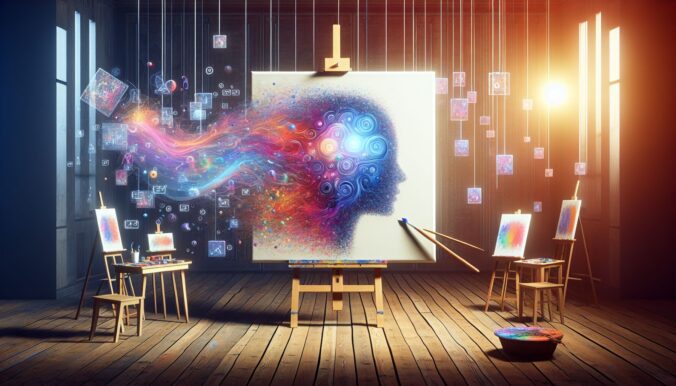
Hey tech enthusiasts and future McLuhans! Today, I’m lounging on my couch with my loyal Labrador snoring gently in the background as he dreams of electric sheep (or at least I like to think so). Meanwhile, I’m very much awake and buzzing with excitement about AI’s electrifying leap into the creative arts. Yeah, the kind of stuff we thought would forever belong in the hands—or, should I say, brushes and quills—of eccentric humans. Let’s dive right into it!
The Dawn of AI Creativity
For years, creativity seemed completely off-limits to machines. I mean, how could we ever expect algorithms to spin yarns like storytellers of old or splash colors on a canvas with the frenzied passion of your run-of-the-mill art prodigy?
Well, turns out we were wrong. The combination of art and artificial intelligence has some weirdly beautiful implications, and honestly? I’m all for it. Picture AI creating moody abstract paintings or composing tunes that tug at your heartstrings. There are a whole lot of what-ifs flying around here, folks, so let’s dive down this rabbit hole.
Neon Dreams: AI in Visual Arts
Generative adversarial networks (GANs) changed everything. These neural networks can create Picasso-esque paint blobs, though whether that’s for better or worse is up for debate. Some clever bit of code hit the right commands, and boom—”art” happened! Companies are working hard to weave together more sophisticated forms of AI-generated visuals.
Take AI systems that synthesize new images from massive datasets. Programs like DALL-E (from our friends over at OpenAI) take typed prompts and transform them into surprisingly compelling art. It’s not quite Android Andy Warhol, but it’s still pretty impressive.
I’m still trying to wrap my head around paintings that feel like they came from some alternate dimension. AI has serious potential as an artistic collaborator, and despite how jarring it can be, there’s something oddly fascinating about it.
Ear Candy and the AI Muse: Artificial Intelligence in Music
How about a soothing jazz-meets-metal jam to soundtrack your work-from-home vibes? AI’s venture into music opens up a whole world of possibilities. Sure, hardcore audiophiles might raise an eyebrow, and rightfully so. This territory deserves some healthy skepticism (and maybe a beer while we think it through).
Musicians are having real ethical debates about AI-generated beats. The technology has shifted how we think about composition when synthetic algorithms can layer harmonic progressions. We’re essentially trading human intuition for digital precision, though the results can be surprisingly nuanced.
Whether it’s AI helping with chord progressions or projects like OpenAI’s Jukebox creating entire genre-spanning compositions, this embrace of experimental sound feels like we’re in the middle of some wild musical laboratory session. The complexity can be overwhelming, but that’s part of what makes it exciting.
Words Still Hold Power: AI Writing
Now here’s where things get really interesting. AI writing tools can generate everything from poetry to news articles, and the quality keeps improving. I’ve seen AI produce surprisingly coherent stories, though they sometimes lack that spark of genuine human experience.
The technology is impressive, but it raises questions about authorship and creativity. When an AI writes a compelling short story, who gets the credit? The programmer? The AI? The person who wrote the prompt? These aren’t just philosophical questions anymore—they’re practical concerns as AI writing becomes more sophisticated.
What fascinates me is how AI handles different writing styles. It can mimic Hemingway’s sparse prose or attempt Shakespearean sonnets. The results aren’t always perfect, but they’re getting close enough to make writers everywhere take notice. Some embrace it as a collaborative tool, others see it as a threat to human creativity.
Leave a Reply