Health information grounded in science, not trends.

Month: June 2025

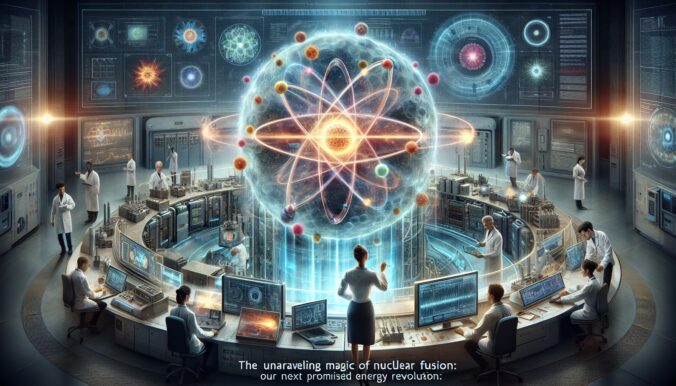
The Unraveling Magic of Nuclear Fusion: Our Next Promised Energy Revolution

Hey, tech curiosity gurus! 🎉 It’s another beautiful day in the era of science fiction slowly rolling over into science fact, and today I want to talk about something that’s been lighting up the scientific world like crazy: nuclear fusion. And trust me, this isn’t just about fancy lasers and shiny gadgets. This could actually solve our energy problems and give us a planet without pollution or energy crises. Grab your drink of choice, settle into your favorite chair, and let’s dig into this atom-smashing topic.

What’s the BUZZ around Fusion, Anyway?

Alright, before we get all excited about nuclear fusion, let’s take a second to understand what all the fuss is about. You remember those science classes where we stumbled through nuclear fission and fusion, right? If you’re like me, your eyes probably glazed over back then. But here’s the deal: Nuclear fusion works by smashing atoms together at incredible speeds so they combine and release massive amounts of energy. It’s basically what the sun does naturally. Unlike fission, which splits heavy atoms apart and can create dangerous waste and Chernobyl-level disasters, fusion’s atomic dance leaves behind almost no harmful pollutants.

The Spark of Hope on the Technical Horizon

“Okay,” I hear your inner skeptic saying, “that sounds great, but when did humans figure out how to control sun-level atomic power?” It’s a fair question with some healthy skepticism, but here’s the thing: 2023 has brought some real breakthroughs in the centuries-long quest for controlled nuclear fusion. Recently, the scientists at the National Ignition Facility (NIF) achieved something incredible. They actually generated more energy from a fusion reaction than they put into it. That might not sound like much, but it’s huge.

And it doesn’t stop there. Private companies like Commonwealth Fusion Systems and Helion Energy are jumping into this high-energy race too, with serious funding behind them. Commonwealth’s experimental reactor isn’t just another particle collider. They’re claiming they’ll have scaled demonstrations ready by 2025. I get excited just thinking about electricity without the guilt or the wallet-crushing bills.

Energizing the Earth: What This Actually Means

Alright, we’ve talked about the theoretical stuff, but you practical folks want to know: how does this actually get us closer to an energy paradise? Well, imagine saying goodbye to our carbon-heavy electric grid. Fusion could change everything.

  1. Clean Energy That Actually Lasts: We’re talking about clean energy for generations. Hydrogen is everywhere, and the fuel supply is basically endless. Climate change activists, this one’s for you.

  2. Economic Game-Changer: Once fusion technology scales up, energy costs could drop dramatically. We’re looking at cheaper electricity, more stable grids, and energy independence for entire countries.

  3. No More Fossil Fuel Dependency: Imagine politicians not having to negotiate with oil-rich nations or worry about gas prices. Fusion could make energy a local, clean, and abundant resource everywhere.

The Hurdles We Still Need to Clear

Now, before we get carried away with our fusion fantasies, let’s be real about the challenges ahead:

  1. Technological Barriers: Controlling fusion reactions is incredibly difficult. We’re talking about containing temperatures hotter than the sun’s core while maintaining precise magnetic fields. The engineering challenges are mind-boggling, and we’re still figuring out how to make reactors that can run continuously rather than in short bursts.
  2. Cost and Scale Issues: Current fusion experiments cost billions of dollars and require massive facilities. Making fusion economically viable means shrinking costs and scaling up production. That’s a huge engineering and manufacturing challenge.
  3. Timeline Reality Check: Even the most optimistic projections put commercial fusion power at least a decade away. Some experts think it could be 20-30 years before fusion becomes widely available. That’s a long time when we need clean energy solutions now.

What Happens Next?

Look, I’m genuinely excited about fusion’s potential, but I’m also trying to stay realistic. The recent breakthroughs are encouraging, and the investment flowing into fusion research is unprecedented. But we’re still in the early stages of what will be a long technological journey.

The good news? Multiple approaches are being tested simultaneously. Government labs, private companies, and international collaborations are all working on different fusion technologies. Some will fail, but others might succeed faster than we expect.

For now, fusion represents hope for a cleaner energy future. Whether that future arrives in 10 years or 30, the work happening today is laying the groundwork for potentially the biggest energy revolution in human history. And honestly? That’s pretty exciting to watch unfold.
The New Frontier: AI Creativity Unplugged

Picture machines writing symphonies, crafting scripts, and creating artworks. Wild to think about, right? AI has moved way beyond number crunching and is now muscling into creative territory that we’ve always thought belonged to humans. Let’s dig into what’s happening when artificial intelligence meets the arts.

When Silicon Dreams of Art

So what exactly are we talking about when we say AI in creative arts? This isn’t your typical optimization algorithm or recommendation engine. We’re watching AI jump from the background straight into the spotlight, trying to channel everyone from Bob Ross to Hermann Hesse. These machines aren’t just lending a hand anymore—they’re grabbing the paintbrush, the pen, and the camera.

Remember when chess players panicked over Deep Blue beating Garry Kasparov? Well, this feels like that moment, but for every creative field at once. Tools like DALL-E are spitting out bizarre, sometimes beautiful images, while GPT-3 writes with a flair that would make Edgar Allan Poe do a double-take. The data doesn’t lie—AI is getting seriously good at this creative stuff.

Digital Da Vincis: The Code Behind the Brush

Okay, let’s get into the nuts and bolts. What actually powers these digital artists? The short answer: massive amounts of data.

At the core, you’ve got machine learning algorithms that have been fed enormous collections of content. We’re talking everything from medieval ballads to modern memes. The training process is intense—these systems crunch through patterns in all that data, learning the rhythms and structures that make great art tick.

Turn one of these trained models loose on a creative task, and you might get something that reads like Charles Dickens writing for the 23rd century. Companies like OpenAI have been pushing these boundaries hard, using deep learning networks to create things that genuinely surprise even their creators.

Creating or Co-Creating? Debating Genius

Here’s where things get messy. Are these AI systems actually creating art, or are they just really sophisticated copy machines? When an algorithm generates a poem or paints a picture, is that genuine creativity or just an impressive remix of everything it learned?

I’ve seen AI-generated pieces that stopped me in my tracks, and others that felt hollow despite their technical polish. The debate splits people pretty evenly. Some argue that creativity requires consciousness, intention, lived experience—things machines don’t have. Others point out that even human artists build on what came before, combining influences in new ways.

What’s clear is that we’re not just talking about tools anymore. These systems make choices, take creative risks, and sometimes produce work that their programmers never anticipated. Whether you call that “real” creativity or not probably depends on how you define creativity in the first place.

Glimpsing the Boundaries of Our Horizon: The New Frontier of Nuclear Fusion

Hey fellow tech enthusiasts! Grab your favorite brew and settle in because today we’re talking about a subject that sparks as much debate over afternoon stand-ups as which Star Wars installment was the greatest (it’s clearly Empire Strikes Back, but I digress). We’re here to bask in the electromagnetic glow of nuclear fusion, a technology that’s pushing us toward the energy-based Promised Land—the potential to harness the power of the stars. Yes, I’m talking about sunshine on steroids, particles colliding at breakneck speeds to save us from ever depending on fossil fuels again. Talk about hitting that techno-utopian sweet spot!

A Brief Background to Stardom Power

First off, let’s understand what the fuss is all about. In simple terms, nuclear fusion is the holy grail of clean, virtually unlimited energy. Unlike nuclear fission, which splits heavy atoms (like unveiling Pandora’s really over-the-top box), fusion merges light atoms together—think of hydrogen atoms becoming helium and dumping massive amounts of energy as a thank-you gift.

This begs the question: “Why haven’t the bright minds over at Los Alamos just given us the answer on a flashy PowerPoint slide?” Well, turns out controlling a bit of stellar magic for us earthlings isn’t a Sunday-afternoon DIY science experiment. It means containing atoms dancing at heart-stopping temperatures—and I do mean heart-stopping; we’re talking 100 million degrees Celsius. Nuclear fireworks with all the fun and none of the burn marks (fingers crossed!).

The Progress We’ve Made So Far

Some days, I imagine what the R&D breakroom banter sounds like in these pioneering labs:

“You heard we hit a new record with our latest test run? Might be 5% more efficient than last quarter!”

High-fives all around. Coffee gets brewed for the third time today.

The reality is that major projects like ITER (the massive international fusion experiment) show how seriously countries worldwide are taking this challenge. We’re talking about Japan, the EU, the USA, and others pooling resources and expertise like never before. The engineering challenges are genuinely mind-bending. You need to create conditions hotter than the sun’s core while keeping everything contained in materials that won’t melt instantly.

Recent breakthroughs have been genuinely exciting though. Labs are hitting energy milestones that seemed impossible just a few years back. The National Ignition Facility achieved fusion ignition in late 2022, which honestly felt like watching science fiction become reality. Private companies are jumping in with fresh approaches and serious funding. Some are betting on magnetic confinement, others on inertial fusion, and a few are trying completely wild approaches that make the whole field feel like a fascinating experiment in human ingenuity.