
The Device That Promised Better Sleep Is Now Keeping You Awake
You bought the wearable because you wanted to sleep better. The marketing promised insight. The algorithms promised optimization. And for maybe two weeks, checking your sleep score felt like progress. Then something shifted. Now you’re waking at 3 a.m., not from insomnia, but from the anticipatory dread of what your readiness score will be tomorrow.

You’re not alone. And it has a name: orthosomnia. It sounds like a tongue twister, but it’s clinically real. The condition describes anxiety about sleep tracking data that actually disrupts your ability to sleep. A 2025 commentary in the Journal of Clinical Sleep Medicine – orthosomnia research documented a 37% rise in reported cases since wearable adoption accelerated. That’s not anecdotal. Sleep specialists are watching their patient intake shift in real time.
The irony is almost too on the nose: the tool designed to measure your sleep is now actively degrading it. The data you thought would empower you is instead creating a feedback loop of anxiety, hypervigilance, and performance pressure that mimics the exact sleep disruption you were trying to fix.
What Your Device Actually Measures (And What It Doesn’t)
Let’s start with accuracy. The current generation of wearables, your Oura Ring Gen4 or WHOOP 4.0, uses photoplethysmography and accelerometry to infer what’s happening in your brain during sleep. That means they’re reading light wavelengths bouncing off your blood vessels and detecting movement. They’re making educated guesses about sleep stages.
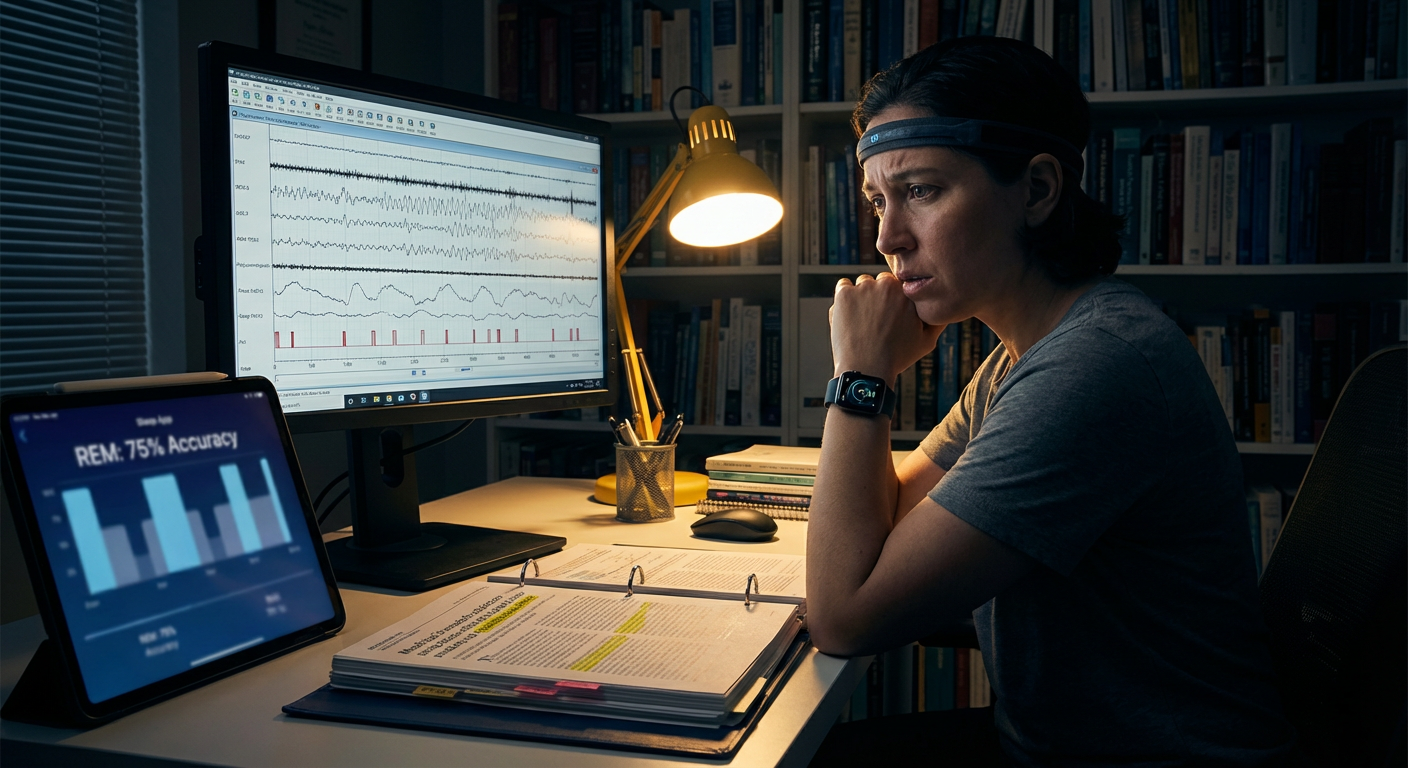
The American Academy of Sleep Medicine on wearable accuracy confirms what sleep researchers have been saying for years: consumer wearables carry a 20-30% error rate in detecting true REM sleep stages compared to polysomnography, the clinical gold standard. That’s not a small margin when you’re making decisions based on the data. You might think you got 68 minutes of REM when you actually got 45. Or vice versa.
Yet these devices now generate heart rate variability scores, detailed sleep staging breakdowns, and “readiness” metrics that promise to tell you whether you’re ready to crush your workout or should rest. Users check these scores an average of 4.2 times per day according to manufacturer data from 2025. Four times daily. You’re not passively tracking anymore. You’re consulting an oracle.
The problem gets worse when you realize that the readiness metric, the number supposedly guiding your daily decisions, comes from a proprietary algorithm. You don’t fully understand how your HRV, sleep duration, and recovery metrics combine to generate that single score. You’re trusting a black box with your behavioral choices.
When the Data Changes Your Life (For the Worse)
A Stanford Sleep Center survey released in late 2025 found something striking: 1 in 4 wearable users reported changing their social plans based on their device’s readiness score. Not because they felt bad. Because the number told them to.
Think about that. One quarter of wearable users are making or breaking social commitments based on an algorithm’s interpretation of metrics that carry inherent measurement error. You skip your friend’s birthday because your readiness score was 41. Three days later, you learn from a colleague that the same wearable company had to issue a firmware update because they were overestimating recovery metrics in users with certain heart rate patterns. Your 41 might have actually been a 58.
This is where orthosomnia stops being theoretical. The anxiety about the score doesn’t just live in your mind. It reshapes your actual behavior. You decline invitations. You adjust your exercise intensity. You start performing sleep optimization theater, magnesium supplements, blackout curtains, temperature-controlled beds, not because the evidence is strong, but because you’re trying to manipulate tomorrow’s number.
The sleep aid app market saw a 43% year-over-year surge in downloads in 2025, with Calm and Headspace reporting record subscription numbers. Some of that growth is legitimate demand for better sleep. A lot of it is people desperately trying to improve their wearable metrics. They’re downloading apps to fix the anxiety created by the wearable that was supposed to fix their sleep.
The Evidence Is Weaker Than the Marketing
Here’s what the research actually shows: wearables are decent at detecting whether you’re asleep or awake. They struggle considerably with sleep stage classification. And their readiness scores, those single numbers reshaping your decisions, are based on proprietary algorithms that haven’t undergone anything close to clinical-grade scrutiny.
The validation studies that do exist are often funded by the device manufacturers or conducted by researchers with financial interests in the companies. That doesn’t automatically mean the data is wrong. But it means you should be skeptical of claims that exceed the evidence base. When WHOOP tells you that your recovery score reflects your true physiological readiness, they’re making a bigger claim than the published research supports.
The anxiety you’re experiencing is neurologically real, but it’s not evidence that the wearable is working. It’s evidence that you’ve fully bought into the premise that a number can accurately capture something as complex as your sleep quality and daily readiness. That premise is seductive. It’s also partially false.
How to Use the Data Without Letting It Use You
This doesn’t mean you should throw your wearable in a drawer. The data can offer genuine insight if you change your relationship to it. Stop checking the score daily. Stop making binary decisions based on single metrics. Look for longer-term patterns instead. Over six weeks or three months, does consistent sleep timing actually correlate with how you feel? Does poor sleep staging data precede days when you genuinely lack energy?
Use the wearable to inform your decisions, not to replace your own sense of readiness. You know how you feel after a 6 a.m. workout following five hours of fragmented sleep. Trust that knowledge. If your readiness score contradicts your actual experience, believe your experience.
If checking the score generates anxiety, set a boundary. Check it weekly instead of daily. Or check it alongside a journal where you note your actual energy, mood, and performance that day. Make the wearable accountable to reality, not the other way around.
Your sleep matters. Your well-being matters. Both matter independently of whether an algorithm accurately captured your REM percentage last night. The goal isn’t a perfect readiness score. It’s sleep that restores you and a life that feels good to live. If the device is preventing the latter, it’s already failed its purpose.
What’s your experience been with wearable sleep data? Have you noticed shifts in your anxiety or decision-making since you started tracking? I’d genuinely like to hear what’s worked and what hasn’t. Real experiences matter more than manufacturer claims, and I suspect a lot of people are quietly going through the same thing.
Recent Comments