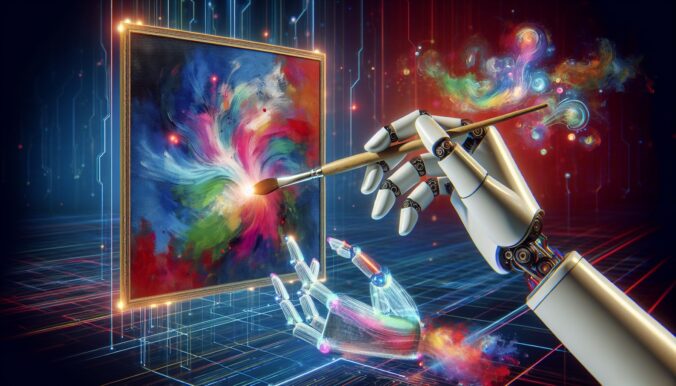
Hey, fellow tech enthusiasts! Today, we’re diving into a corner of our digital revolution that’s painting a whole new picture—literally. It’s Artificial Intelligence making its mark on the creative arts. For anyone who’s ever wondered what it’d be like if a machine could match (or perhaps eclipse) the creative genius of Van Gogh or Da Vinci, we’re entering into that territory. Think of this as a front-row seat to AI picking up the paintbrush, the pen, or maybe even the ballet slippers. Ready to see what the brave new world of AI-driven creativity looks like? Let’s jump right in.
A New Muse on the Block: AI and Art
I’m sure you’ve heard of AI by now—it’s been solving problems faster than I can type. But, have you ever imagined it creating something as subjective and soulful as art? Initially, I was skeptical, probably much like you are now. The mere thought of Siri keeping a dream diary felt a bit Silicon Valley meets Salvador Dalí.
However, Artificial Intelligence has and continues to break through in remarkable ways. Platforms like DeepArt and DALL-E 2 (from our friends at OpenAI) have shown that creativity doesn’t belong to humans alone. AI is now learning to mimic artistic styles, combining them in complex ways to output new artworks that, were it not for the clunky CPU language attributed to AI-ridden titles, might happily find themselves framed and hanging in a gallery.
Where Creativity Meets Algorithms: How It Works
So, how does this work exactly? I’ll hold off on pretending to understand neural networks better than I know my own grocery list. But generally, AI creates art using a type of neural system called Generative Adversarial Networks (GANs). For the uninitiated, GANs are like an ongoing debate class. They’re made up of a ‘generator’ that creates something new and a ‘discriminator’ that judges it.
What’s fascinating about this process is the possibility of styles clashing in impossible intersections that normal artistry wouldn’t conceive. Different artistic approaches come together in ways that would make traditional masters scratch their heads. Imagine Picasso’s cubism mixed with Monet’s impressionism, all processed through an algorithm’s interpretation.
Digital Brushes in Broader Strokes: The Applications
Now, we get to the juicy part: applications! From VR-enhanced experiences to digitally curated ad campaigns, AI-generated art extends well beyond being just a curiosity in the art lover’s collection.
Comic Designs Reimagined
AI’s impact on animation opens up endless possibilities for storytelling. We’re talking about illustrated narratives that can shift from childhood nostalgia to epic adventures with the click of a button.
Comic design relies heavily on visual impact and boundless imagination—both areas where AI performs surprisingly well. Studios are now experimenting with AI engines that can generate character designs, backgrounds, and even entire panels based on script inputs. The technology blends traditional craft with digital innovation in ways we’re still figuring out.
Reinventing Marketing Perspectives
The marketing world has taken notice too. AI can generate custom visuals for campaigns, create personalized content at scale, and even develop entirely new aesthetic approaches that human designers might never have considered.
Companies are using AI to create visual content that speaks to different audience segments in ways that feel both fresh and familiar. It’s changing how we think about brand imagery and visual communication across the board.
The Human Question: Implications for Traditional Artists
Here’s where things get complicated. When you introduce the idea that AI can create art, traditional artists understandably get nervous. I’ve talked to several artists about this, and the reactions range from fascination to outright concern about their livelihoods.
Some see AI as just another tool, like Photoshop was in the ’90s. Others worry it might replace human creativity altogether. The truth probably lies somewhere in between. AI can generate images quickly and cheaply, but it lacks the lived experience, cultural context, and emotional depth that human artists bring to their work. At least for now.
What we’re seeing is more collaboration than replacement. Artists are using AI to brainstorm ideas, generate rough concepts, or create base images they can then modify and refine. It’s becoming less about AI versus human creativity and more about how the two can work together.
Recent Comments