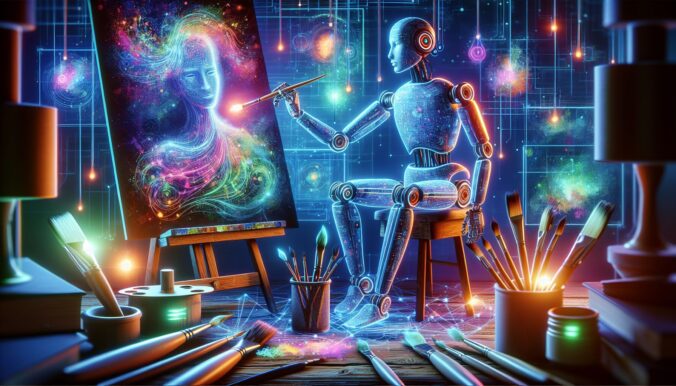
Hey tech enthusiasts! Today I’ve got something that’s been blowing my mind lately, especially if you’re like me and fascinated by how 0s and 1s are crashing into the world of creative arts. We’re talking about AI in creative fields, where algorithms are actually becoming artists and data is creating some seriously wild visuals. If Leonardo da Vinci were around today, I’m pretty sure he’d be tinkering with a Mona Lisa bot in his spare time!
Art by Algorithm: The New Van Gogh?
Let’s start with art galleries, those quiet, intimidating spaces where people stand around squinting at paint splatters and nodding knowingly. Here’s the kicker: the newest sensation hanging on those white walls might not be from a human artist at all, but from a piece of software that’s apparently got great taste in color palettes. AI is seriously shaking up the art world, and collectors are paying serious money for it.
AI-generated artwork goes way beyond just randomly mashing keys on a computer. You’ve probably heard of Google’s DeepDream or Prisma. But the real game-changer is GANs (Generative Adversarial Networks), where two AI systems basically battle it out, one creating images and the other critiquing them until they produce something so surreal that Salvador Dalí would probably grow another mustache curl out of pure jealousy.
Want proof that AI art is legit? “Portrait of Edmond Belamy,” created by Paris-based collective Obvious using AI, sold at Christie’s for $432,500. Yeah, you read that right. That’s a lot of zeros for something made of zeros and ones. Traditional artists are probably having some mixed feelings about that price tag.
Music from the Machine
But we’re not stopping at visual art here. AI is also composing music that actually sounds good, which is pretty wild when you think about how computers used to just make annoying beeping noises. Remember dial-up internet sounds? Thank god those days are over.
Music platforms powered by AI are completely changing how we think about composition. Take OpenAI’s MuseNet, which lets anyone generate songs that blend genres in ways that shouldn’t work but somehow do. Rock meets jazz, orchestral gets mixed with electronic beats. It’s like having a jam session with a really creative robot that never gets tired or argues about what to play next.
Here’s where it gets tricky though. Is AI a helpful tool that makes musicians more creative, or is it going to replace them entirely? Picture this: a guitarist sharing the stage with an AI that can remix songs in real-time. Are we heading toward concerts where the audience can’t tell if they’re cheering for human creativity or machine precision? It’s exciting and a little unsettling at the same time.
Writing: AI Taking Bigger Swings at Literature
And then there’s writing. You might be wondering if robots are about to start cranking out the next Shakespeare. Tools like GPT-3 are already helping writers brainstorm ideas and even generate entire paragraphs based on just a few prompts. It’s like having a writing partner that’s read everything ever written and can help you find the perfect word when you’re stuck.
Some authors are embracing AI as a collaboration tool, using it to overcome writer’s block or explore new narrative styles. Others worry that automated writing will flood the market with generic content. I get both sides. There’s something magical about human creativity that comes from lived experience, emotions, and that messy process of being human. But I also can’t deny that some AI-generated text is genuinely impressive.
So What’s Next: Hopes and Fears
Talking to fellow creatives about this stuff, I hear excitement mixed with genuine concern. On one hand, AI tools could democratize creativity, letting anyone with an idea create art, music, or stories without years of technical training. That’s pretty amazing when you think about it.
On the other hand, there’s the fear that we’re automating away human creativity itself. What happens to artists when anyone can generate a masterpiece with a few clicks? Will we lose something essentially human in our rush to embrace these new tools? And who gets credit (and royalties) when an AI creates something based on millions of existing works it learned from?
Conclusion: Creative Partner or Creative Replacement?
I think we’re still figuring out where AI fits in the creative world. Right now, it feels more like a really sophisticated tool than a replacement for human creativity. The best AI art I’ve seen still needs human input, curation, and that indefinable spark that comes from having actual experiences and emotions to draw from.
But honestly? The technology is moving so fast that I might be completely wrong about where this is headed. Maybe in five years, AI will be creating art that moves us in ways we never expected. Or maybe we’ll find the sweet spot where human creativity and machine capability work together to make something neither could achieve alone. Either way, it’s going to be interesting to watch.
Recent Comments