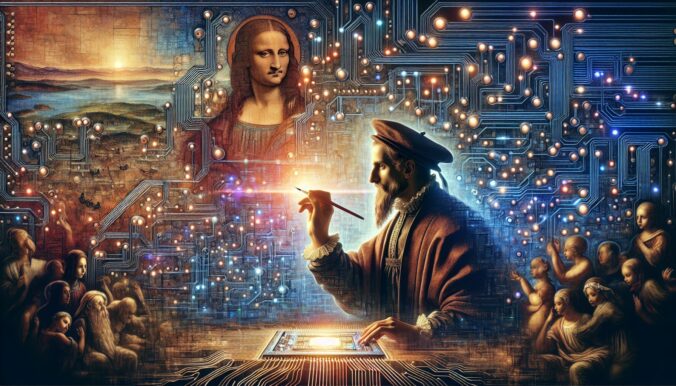
Hey there fellow tech enthusiasts! Grab a cup of your finest artisan roast and settle in because today we’re exploring something pretty wild: how Artificial Intelligence and the Creative Arts are colliding in ways nobody saw coming ten years ago. It’s happening, folks: tech geeks like us might just find ourselves at the heart of the next big renaissance.
The Unexpected Artist: When Machines Get Creative
When I first heard about AI making art, I rolled my eyes so hard I nearly pulled a muscle. Could a machine ever truly be “creative”? There’s no easy answer to that question, but what I’ve seen lately has me reconsidering everything.
Case in point: GPT-4 and DALL-E. Here we have a language model cranking out short stories that could give some published authors a run for their money, and its visual counterpart creating artwork that’s honestly better than half the stuff I see in galleries. These OpenAI tools have turned creativity into this weird collaborative dance between humans and machines, and I’m not sure how I feel about it yet.
How TikTok’s Algorithm Became the New Music Executive
Remember when we discovered music through radio or that one friend who always knew about bands before they got big? Now TikTok’s AI decides what’s cool based on fifteen-second clips. The algorithm analyzes everything from beats per minute to which songs make people dance like idiots, spotting patterns that predict the next viral hit.
There’s something both fascinating and terrifying about AI making these cultural calls. It’s like letting a really smart robot decide what goes on your Spotify playlist. Could anyone have predicted we’d end up here?
When Artists Collaborate with Code
Why stop at recommending music when AI can create it too? Artists like Holly Herndon have started collaborating with AI to generate musical compositions that push boundaries in ways human composers alone couldn’t manage. You get this interesting mix of human intuition and mathematical precision that creates something genuinely new.
The visual arts are getting the same treatment. Students at Aalto University in Finland worked on a project called ArtSy, using AI to analyze and recreate visual styles in ways that go way beyond simple filters. These aren’t flat, boring computer graphics. They’re layered, complex pieces that actually make you stop and think.
Of course, this whole movement has created some chaos too. The NFT market exploded partly because of AI-generated art, leading to all sorts of debates about what constitutes “real” creativity and who owns what when a machine helps create it.
The Messy Reality of AI Creativity
Look, it’s not all smooth sailing. We’re dealing with some serious questions here. When AI creates something beautiful, who gets the credit? What happens to human artists trying to make a living? And honestly, sometimes the results are just plain weird or problematic in ways the programmers never intended.
There are copyright issues, ethical concerns about training data, and the uncomfortable reality that AI might be really good at mimicking creativity without actually understanding what it’s creating. It’s like watching a really sophisticated parrot that can paint masterpieces but has no idea what a sunset actually means.
Where Do We Go from Here?
So what does this all mean for us tech folks? I think we’re watching the birth of a new kind of creativity, one where the tools are getting smart enough to be creative partners rather than just instruments. It’s exciting and unsettling at the same time.
The artists who figure out how to work with AI rather than against it are probably going to create some incredible stuff. Meanwhile, those of us building these systems need to think harder about the implications of what we’re making. We’re not just writing code anymore; we’re shaping how humans express themselves.
Whether this leads to a true renaissance or just a really sophisticated form of creative automation remains to be seen. But one thing’s certain: the intersection of AI and creativity is going to keep surprising us, and I’m here for the ride.
Recent Comments