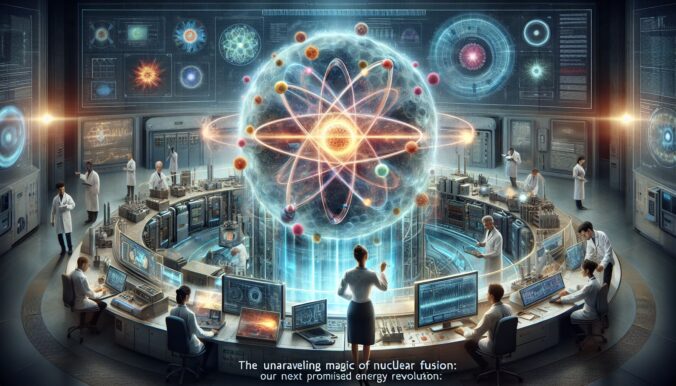
Hey, tech curiosity gurus! 🎉 It’s another beautiful day in the era of science fiction slowly rolling over into science fact, and today I want to talk about something that’s been lighting up the scientific world like crazy: nuclear fusion. And trust me, this isn’t just about fancy lasers and shiny gadgets. This could actually solve our energy problems and give us a planet without pollution or energy crises. Grab your drink of choice, settle into your favorite chair, and let’s dig into this atom-smashing topic.
What’s the BUZZ around Fusion, Anyway?
Alright, before we get all excited about nuclear fusion, let’s take a second to understand what all the fuss is about. You remember those science classes where we stumbled through nuclear fission and fusion, right? If you’re like me, your eyes probably glazed over back then. But here’s the deal: Nuclear fusion works by smashing atoms together at incredible speeds so they combine and release massive amounts of energy. It’s basically what the sun does naturally. Unlike fission, which splits heavy atoms apart and can create dangerous waste and Chernobyl-level disasters, fusion’s atomic dance leaves behind almost no harmful pollutants.
The Spark of Hope on the Technical Horizon
“Okay,” I hear your inner skeptic saying, “that sounds great, but when did humans figure out how to control sun-level atomic power?” It’s a fair question with some healthy skepticism, but here’s the thing: 2023 has brought some real breakthroughs in the centuries-long quest for controlled nuclear fusion. Recently, the scientists at the National Ignition Facility (NIF) achieved something incredible. They actually generated more energy from a fusion reaction than they put into it. That might not sound like much, but it’s huge.
And it doesn’t stop there. Private companies like Commonwealth Fusion Systems and Helion Energy are jumping into this high-energy race too, with serious funding behind them. Commonwealth’s experimental reactor isn’t just another particle collider. They’re claiming they’ll have scaled demonstrations ready by 2025. I get excited just thinking about electricity without the guilt or the wallet-crushing bills.
Energizing the Earth: What This Actually Means
Alright, we’ve talked about the theoretical stuff, but you practical folks want to know: how does this actually get us closer to an energy paradise? Well, imagine saying goodbye to our carbon-heavy electric grid. Fusion could change everything.
-
Clean Energy That Actually Lasts: We’re talking about clean energy for generations. Hydrogen is everywhere, and the fuel supply is basically endless. Climate change activists, this one’s for you.
-
Economic Game-Changer: Once fusion technology scales up, energy costs could drop dramatically. We’re looking at cheaper electricity, more stable grids, and energy independence for entire countries.
-
No More Fossil Fuel Dependency: Imagine politicians not having to negotiate with oil-rich nations or worry about gas prices. Fusion could make energy a local, clean, and abundant resource everywhere.
The Hurdles We Still Need to Clear
Now, before we get carried away with our fusion fantasies, let’s be real about the challenges ahead:
- Technological Barriers: Controlling fusion reactions is incredibly difficult. We’re talking about containing temperatures hotter than the sun’s core while maintaining precise magnetic fields. The engineering challenges are mind-boggling, and we’re still figuring out how to make reactors that can run continuously rather than in short bursts.
- Cost and Scale Issues: Current fusion experiments cost billions of dollars and require massive facilities. Making fusion economically viable means shrinking costs and scaling up production. That’s a huge engineering and manufacturing challenge.
- Timeline Reality Check: Even the most optimistic projections put commercial fusion power at least a decade away. Some experts think it could be 20-30 years before fusion becomes widely available. That’s a long time when we need clean energy solutions now.
What Happens Next?
Look, I’m genuinely excited about fusion’s potential, but I’m also trying to stay realistic. The recent breakthroughs are encouraging, and the investment flowing into fusion research is unprecedented. But we’re still in the early stages of what will be a long technological journey.
The good news? Multiple approaches are being tested simultaneously. Government labs, private companies, and international collaborations are all working on different fusion technologies. Some will fail, but others might succeed faster than we expect.
For now, fusion represents hope for a cleaner energy future. Whether that future arrives in 10 years or 30, the work happening today is laying the groundwork for potentially the biggest energy revolution in human history. And honestly? That’s pretty exciting to watch unfold.
Recent Comments