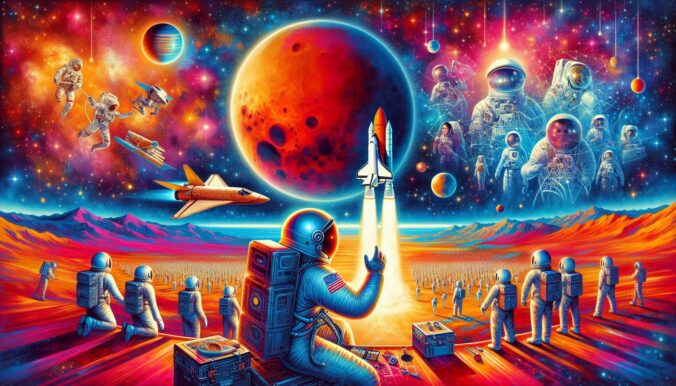
Hey space enthusiasts, tech junkies, and dreamers of all dimensions! Grab your imaginary rocket, buckle up, and let’s talk about something that’s literally out of this world: we’re in the throes of a modern-day space renaissance, and it’s damn exhilarating. Today’s blog explores the wild new frontier facing humanity—space travel—and how our generation might very well be the one to make Mars our second home. So put down that half-finished cold brew, and let’s dive right in.
The New “Space Race”: A Whole Lot Weirder and Wildly More Promising
Is there anything more exciting than witnessing potentially one of humanity’s greatest leaps—cycling through your Monday Twitter feed of cat videos and suddenly hearing about asteroids, interplanetary collaborations, and moon bases? My inner science-fiction nerd feels like it’s Christmas every day.
There’s a comparison to be made here: Remember those clunky dial-up modems and chunky CD players? That’s what earlier space efforts looked like. Today’s missions feel more like we jumped straight to smartphones and streaming everything in 4K. The technology leap is staggering.
Our modern-day “Space Race” isn’t just a battle between superpowers anymore. It’s become this wild free-for-all with visionaries, billionaires, and startups all throwing their hats in the ring. NASA’s still doing incredible work, but now they’re joined by SpaceX making rocket landings look routine, Blue Origin planning lunar tourism, and dozens of smaller companies each tackling different pieces of the puzzle.
The Players: Visionaries Who Actually Deliver
Look, I’ll be honest—some of these space moguls can be pretty polarizing figures. But watching SpaceX land those Falcon 9 boosters? That never gets old. Every time I see one of those rockets come screaming back to Earth and stick the landing, I get goosebumps. It’s like watching science fiction become mundane reality.
Elon Musk talks big about Mars colonies, and yeah, sometimes his timelines are optimistic to put it mildly. But SpaceX has actually delivered on enough promises that I’m starting to believe the crazier ones might happen too. Jeff Bezos with Blue Origin is taking a different approach, focusing on lunar infrastructure first. Smart move, honestly—the moon could be our practice run before we tackle Mars.
Then you have all these smaller companies working on everything from asteroid mining to space hotels. Some of it sounds absolutely bonkers, but that’s exactly how the internet felt in 1995. Sometimes bonkers is just early.
What’s Actually Possible: Beyond the Hype
Here’s where I get genuinely excited. We’re not just talking about sending a few astronauts on suicide missions anymore. The plans coming together involve real infrastructure—fuel depots in space, rotating crews, actual sustainable presence on other worlds.
Mars isn’t going to be like the movies where we terraform the whole planet in a decade. The reality will probably be underground habitats, dome cities, and a lot of recycled everything. But that’s still incredible when you think about it. Humans living permanently on another planet. Kids being born who might never see Earth.
The moon’s looking more realistic for the short term. It’s close enough for quick supply runs, and the low gravity makes launching to Mars easier from there. Plus, if we can figure out lunar mining, that could change everything about how we build things in space.
Where We Go From Here
I try not to get too starry-eyed about timelines because space is hard and things go wrong. But man, the momentum feels different this time. We have reusable rockets, international cooperation that actually works, and enough private money flowing in to fund some serious attempts.
Will I live to see people walking on Mars? Maybe. Will my kids? I’m betting yes. And honestly, even if we don’t make it to Mars in the next 20 years, all the technology we’re developing along the way—better life support, advanced materials, closed-loop systems—that stuff will change life on Earth too.
The next decade is going to be wild. Lunar bases, asteroid prospecting, maybe even the first Mars landing attempts. I plan to watch every single launch I can. This is history happening, and we get front-row seats.
Leave a Reply