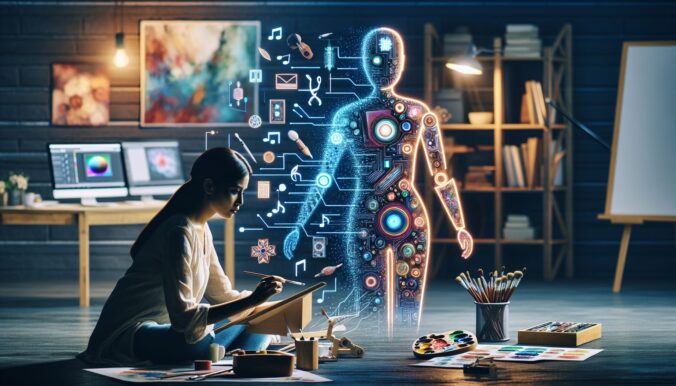
Hey, tech wanderers! Pull up a chair and let’s dive into a realm that most of us probably dreamed about as kids. You know the one: a world where computers not only listen to us but can chew on ideas, spit them back out in crazy insightful ways, and co-author our lives like never before. I probably wrote fan-fic about it and thought, nah, that’s just sci-fi. Fast forward to 2023, and here we are knee-deep in the future! Today, I’m going to chat about something close to my tech-loving heart: AI in the creative arts. Specifically, how ChatGPT and its friends are shaking things up in really wild ways. Sound good? Cool, read on!
The Rise of ChatGPT in Creative Spaces
Alright, first things first, let’s hit rewind. Natural Language Processing has been on this meteor-speed rise, crashing through creative industries like a bull in a china shop. If you’ve been living under a rock (or off Twitter), let me introduce you to the poster child of AI’s creative revolution: OpenAI’s ChatGPT. These language models get trained on oceans of data. I’m talking Wikipedia, WebText, Project Gutenberg, and loads more. Thanks to all that training, they don’t just mimic human language. They predict context and deliver text smoother than a jazz saxophonist. They’re not here to steal the writer’s job or mess with the scriptwriter’s vision, but damn, do they expand their creative toolbox.
When Text Meets Life
Let’s get into the juicy details of how ChatGPT is dancing with storytelling. Picture a neural network that can devour libraries of fiction, non-fiction, chat logs, opinion pieces, and spit them all back out like some kind of literary DJ remix. It does something special with these stories. With every suggestion it makes, it breaks free from old constraints and gives creativity a shot of pure possibility. Until suddenly, one screenplay later, you’re exploring territory no human writer has mapped before.
Look, I’m not sitting here telling you to ditch your word processor. This tool is more like a creativity amplifier for authors. Need help sketching out a rough chapter outline? It’s got you. Want to brainstorm character motivations in seconds? Done. These models take our ideas, our grit, our vision, then help us build infinite universes as diverse as literature itself.
Upgrading Storyboarding with AI
We’ve covered the basics, but creative fiction isn’t just about raw text anymore. We want chaos, fusion, the whole techno-circus of possibilities rather than boring content generators churning out the same old stuff. It gets pretty exciting when films and stories push beyond traditional boundaries.
When Inspiration Strikes
When a novelist watches AI conjuring up fresh ideas, it’s like watching magic happen. You get surreal dialogue possibilities, unexpected plot twists, and story directions that make you think “Holy shit, I never would have gone there.” Companies and creative studios are jumping on this train, using AI-assisted storyboards to open up artistic lives and never-ending creative possibilities. It’s not about replacing human creativity. It’s about cranking it up to eleven.
Why settle for ordinary storytelling? That’s exactly what today’s artists are asking themselves. AI tools are helping creators explore fractured narratives, experimental formats, and visual concepts that would have taken months to develop manually. The technology isn’t just accelerating the creative process. It’s revealing new creative territories we didn’t even know existed.
Challenges: The Creative Control Question
Before we get too carried away with the possibilities, let’s pump the brakes for a reality check. AI creative tools aren’t without their problems. There’s the whole question of originality. When an AI suggests a plot twist based on thousands of existing stories, is that innovation or just really sophisticated recycling? And don’t get me started on the copyright minefield we’re walking into.
The biggest misconception I see floating around is that AI will replace human creativity entirely. That’s bullshit. What we’re really looking at is a new kind of collaboration. The AI brings processing power and pattern recognition. Humans bring emotion, lived experience, and the ability to know when something feels authentic versus when it’s just technically correct.
The Future is Creative Partnership
Here’s where I think we’re headed, and honestly, it’s got me pretty excited. The future isn’t about AI taking over creative work. It’s about humans and AI becoming creative partners in ways we’re just starting to figure out. Picture a novelist who can bounce ideas off an AI that knows every story structure ever written, or a screenwriter who can test dialogue against an AI trained on decades of successful scripts.
We’re still in the early days of this partnership. The tools are getting better every month, and creative professionals are finding new ways to integrate them into their workflows. Some days it feels like we’re building the creative equivalent of the printing press, something that will fundamentally change how stories get told. Other days it feels like we’re just playing with fancy autocomplete. Probably the truth is somewhere in between, but damn if it isn’t fun to find out.
Leave a Reply