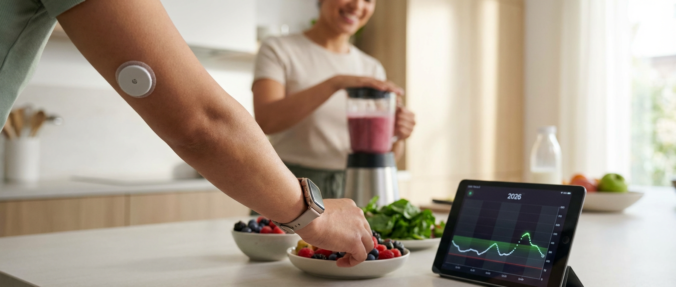
The Wellness Gold Rush is Real
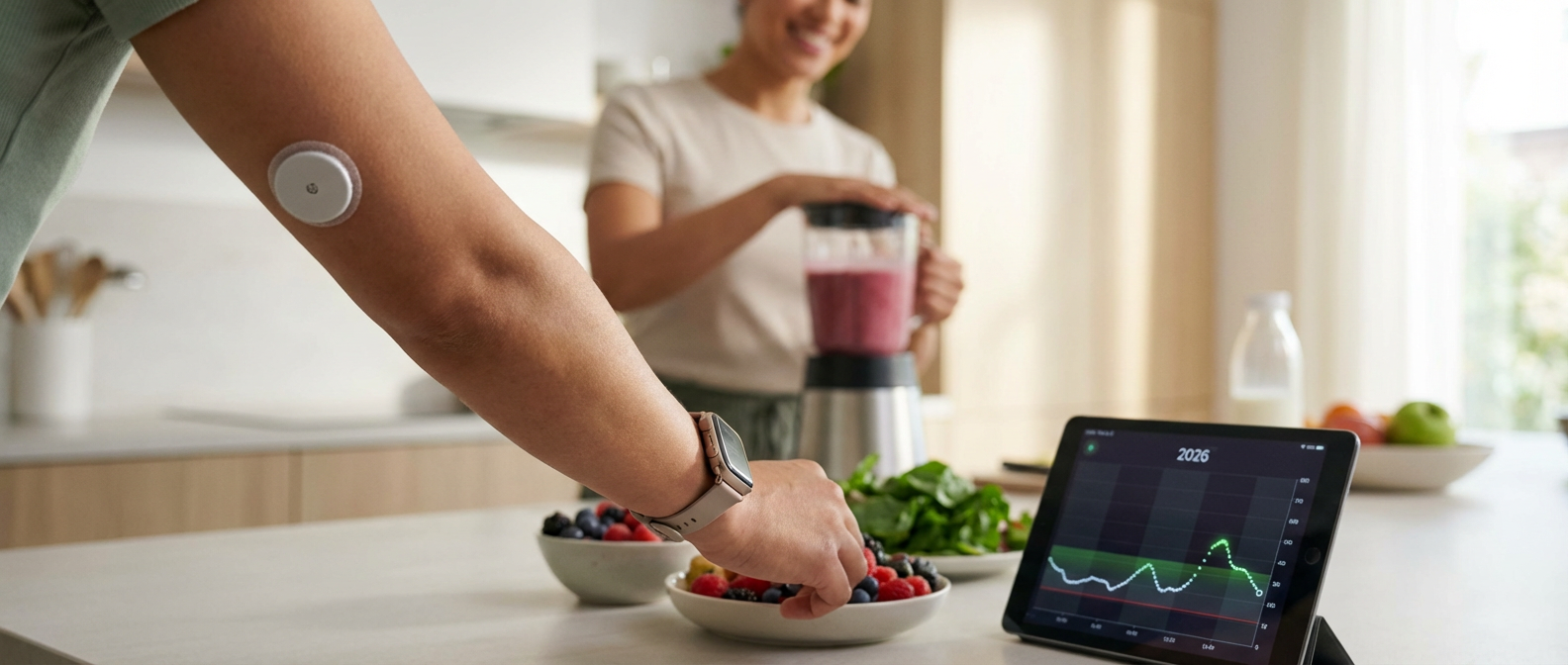
By January 2026, over 500,000 non-diabetics had strapped a continuous glucose monitor onto their arm. That’s half a million people paying close attention to something their bodies have been managing without their conscious intervention for their entire lives. The device doing most of this heavy lifting? Dexcom Stelo, which launched as the first over-the-counter CGM approved by the FDA specifically for people without diabetes. It hit the market in 2024 and reached half a million users in just 18 months. That’s not a gradual adoption curve. That’s a sprint.
You don’t need to scroll far on Instagram to understand why. Jessie Inchauspé, the viral “Glucose Goddess,” has built a 4-million-strong following by making glucose spikes feel like something you can actually control. She released her second book in 2025, and her influence has become impossible to separate from the surge in consumer demand for these devices. People aren’t just curious anymore. They’re convinced that understanding their blood sugar is the missing piece to feeling better, performing better, aging better.
The question isn’t whether the trend exists. It clearly does. The real question is whether it’s worth your money and attention if you don’t have diabetes.
What the Data Actually Shows (and Doesn’t)
Here’s where things get interesting. A 2025 Stanford Medicine study tracked 1,000 non-diabetic CGM users and found that two-thirds of them made meaningful dietary changes after watching their glucose spike in real time. That sounds great. That sounds like the device works. But then the study kept tracking. Six months later, only one-third of those people were still making those changes. The initial motivation had evaporated. The behavior hadn’t stuck.
This is the unsexy reality of behavior change: seeing the problem and fixing the problem are two completely different skills. A CGM is phenomenal at showing you the problem. It’s a tiny robot that doesn’t lie. You eat a bagel, your glucose shoots up. You eat that same bagel with peanut butter and eggs, your glucose rises more gently. The device delivers this feedback in real time, and for exactly 67% of people in that Stanford study, it was motivating enough to make a change.
But sustained change? That requires something the device cannot provide. It requires habit architecture, understanding why you’re making the change and what you’re actually trying to optimize for, and genuine patience with yourself. Most people don’t have a structured plan to move through that door, even when the door is clearly visible.
There’s also a real tension in the professional medical world. The American Diabetes Association Standards of Care 2025 explicitly states there is insufficient evidence to recommend CGM for metabolically healthy adults. The people actually trained in blood sugar management are saying: not yet. We don’t have enough proof this helps you. Meanwhile, hundreds of thousands of non-diabetics are paying out of pocket to find out.
Let’s Talk About the Cost and What You’re Actually Buying
Abbott’s Lingo CGM, designed for wellness-conscious consumers, retails for approximately $49 per two-week sensor. Do the math. That’s roughly $1,274 per year for continuous monitoring. For many people, that’s a gym membership, a therapist, a nice vacation, or several months of quality supplements. It’s real money.
What are you actually getting for $1,274? Two things. One: data about how your body responds to specific foods, stress, and sleep. Two: the possibility that this data changes your behavior in a lasting way. The data part is guaranteed. The behavior change part is not. You cannot buy sustained habit change from a sensor. You can only buy information.
Some people are willing to pay $1,274 for information. If you’re an athlete optimizing performance, or someone with a strong family history of type 2 diabetes trying to understand your metabolic trajectory, or someone who genuinely responds well to quantified feedback, this might be a worthwhile investment. You’re not paying for the device to fix you. You’re paying for it to teach you something specific about yourself that you’ll then use to make a deliberate change.
But if you’re approaching this as a passive solution, as a way to magically understand health without doing the harder work of behavior change, the device will feel like an expensive version of something you already know: that processed food affects your body differently than whole food, and that stress and poor sleep make everything worse.
The Long Game: When This Actually Makes Sense
Here’s what I genuinely think matters. The trend toward Dexcom Stelo OTC CGM information and consumer glucose monitoring isn’t going away. It’s probably going to get cheaper and easier to access. Five years from now, wearing a CGM might feel as normal as tracking steps on your phone. That’s not inherently bad. Real-time feedback is powerful.
What matters is why you’re considering it. Are you trying to outrun genetics? Optimize something specific? Genuinely understand how your body works? Those are solid reasons. Are you trying to fix something you could fix with sleep, movement, and less processed food? The device won’t do that for you. You have to do that for you.
The long game isn’t wearing a CGM. It’s building a relationship with how your body actually works, independent of what a device tells you. The device is just a teacher. You still have to learn.
If you’re considering this, try something first. For two weeks, before you pay $1,274, change one thing deliberately. Add vegetables to one meal per day. Move your body for 20 minutes. Sleep 30 minutes more. Notice what changes. Notice how you feel. Then decide if you need a device to tell you what you already suspect.
What’s Your Question?
I’m curious what brought you here. Are you thinking about trying a CGM? Have you already been wearing one? I’d genuinely like to know what the real deciding factor was, or what you actually got out of it. The hype is loud, but the actual human experience is way more interesting. Leave a comment below and let’s talk about what longevity actually looks like for you.
Recent Comments